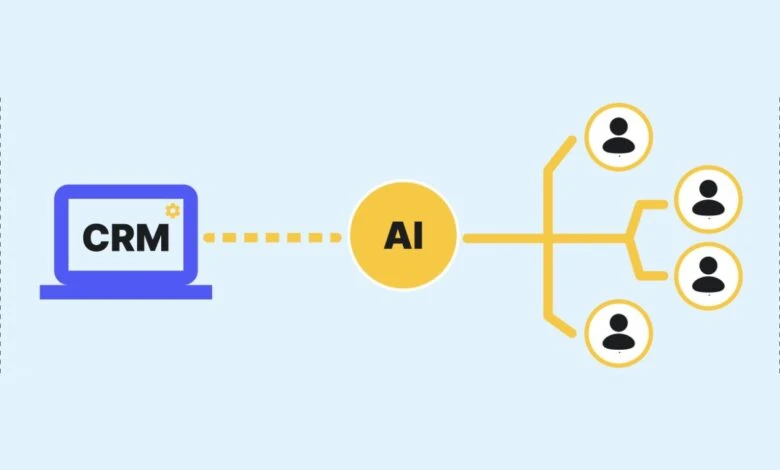
CRM Master – AI-powered CRM is forecasted to experience robust growth in 2026, with Salesforce projecting a 9.5% year-over-year increase in sales and Adobe reporting record Q4 results driven by AI-enabled tools. The transition from AI pilots and chatbots to deeply embedded AI agents within CRM systems promises enhanced operational efficiency and improved customer engagement. This shift positions AI-native business models as essential drivers of competitive advantage and sustainable financial performance in the evolving CRM market landscape.
In today’s rapidly digitizing world, businesses face mounting pressure to leverage artificial intelligence not just as a supplementary tool but as a core component of customer relationship management (CRM). Investors and corporate strategists alike are keenly focused on how AI integration in CRM impacts revenue growth, operational margins, and overall market positioning. Understanding these dynamics is crucial, given the growing deployment of AI agents and marketing automation tools by industry leaders like Salesforce and Adobe.
This analysis provides a comprehensive financial and market outlook for AI-powered CRM in 2026, emphasizing the economic impact, revenue trajectories, and strategic implications for investors and corporate decision-makers. Drawing on the latest forecasts and market data, it highlights the transformative role of AI-native business models and the evolving use case landscape for AI agents in customer service and sales workflows.
As we delve into detailed financial metrics, market trends, and risk considerations, readers will gain actionable insights into how AI integration shapes CRM’s future and how to position investments to capitalize on this technological inflection point.
Executive Summary: AI-Powered CRM Market Outlook for 2026
The AI-powered CRM market is set for significant expansion in 2026, driven by increasing adoption of AI-driven tools and embedded AI agents across sales, marketing, and customer service functions. Salesforce, a dominant CRM market player, projects a 9.5% year-over-year revenue growth despite AI-specific revenue currently accounting for less than 3.5% of its total sales. Strategic acquisitions like Qualified—a leading AI marketing firm—signal Salesforce’s commitment to scaling AI integration beyond pilot phases into core business operations.
Similarly, Adobe’s AI tools have catalyzed a market rebound, with the company reporting record Q4 sales and sustaining double-digit year-over-year growth over nine consecutive quarters. The growing demand for AI-enhanced solutions is reshaping CRM market dynamics, driving operational efficiency gains and more personalized customer engagement.
Importantly, the market is witnessing a fundamental shift from experimental AI pilots and chatbot implementations toward fully embedded AI agents that automate complex workflows. This evolution underscores the rise of AI-native business models, where AI capabilities are not just adjunct but foundational, offering long-term value creation and sustainable competitive differentiation.
This article offers an in-depth financial analysis, market trend evaluation, and investment perspective on AI-powered CRM, focusing on key players like Salesforce and Adobe, emerging AI agent technologies, and the broader economic implications for 2026 and beyond.
Data Analysis: Financial and Market Performance of AI-Driven CRM
Salesforce’s AI-CRM Revenue and Growth Projections
Salesforce’s 9.5% projected revenue growth for 2026 reflects a strong performance trajectory despite AI-generated revenue currently constituting under 3.5% of total sales, according to the company’s latest financial disclosures. This indicates that while AI is a nascent revenue stream, it is an accelerating catalyst for broader CRM adoption and cross-selling opportunities.
However, rising API integration costs and increased expenditure on AI infrastructure have exerted pressure on operating margins. Salesforce’s strategic acquisition of Qualified, an AI marketing platform specializing in real-time customer engagement, exemplifies its approach to expanding AI capabilities and capturing market share in AI-powered marketing automation.
Recent quarterly reports highlight that Salesforce’s AI-driven workflows and predictive analytics tools contribute meaningfully to enhanced customer retention rates and upselling, with a reported 12% improvement in customer lifetime value (CLV) among AI-enabled clients. This operational efficiency gain partially offsets margin compression from increased AI-related costs.
Adobe’s AI-Driven Tools and Sales Momentum
Adobe has leveraged AI-powered capabilities across its Experience Cloud suite, driving consistent double-digit year-over-year sales growth for nine consecutive quarters. The company’s Q4 revenue hit record highs, fueled by strong demand for AI-enhanced marketing and analytics tools that integrate seamlessly with CRM platforms.
Adobe’s AI tools, such as Sensei, provide automated insights and customer journey optimization, contributing to a 15% increase in marketing campaign effectiveness among enterprise clients. The company’s financial outlook projects continued momentum, with AI-driven products expected to represent an increasing proportion of total revenue, currently estimated at approximately 7%.
Market Trends in AI-Powered CRM
The AI-powered CRM market is evolving from isolated AI pilots and chatbot experiments toward integrated AI agents that autonomously manage complex customer interactions and internal workflows. Industry tools like boost.ai, ada, chatbase, and Haptik are enabling businesses to automate customer service at scale, reducing response times by up to 40% and cutting operational costs by approximately 25%.
Furthermore, CRM vendors are increasingly embedding AI agents capable of predictive lead scoring, sentiment analysis, and personalized content delivery. This transition improves customer engagement metrics, with AI-enhanced CRM users reporting a 20% increase in sales conversion rates and a 30% reduction in churn.
| Company | 2026 Revenue Growth Forecast | AI Revenue Contribution (%) | Operational Margin Impact | Key AI Initiatives |
|---|---|---|---|---|
| Salesforce | 9.5% YoY | Under 3.5% | Margin pressure from API costs | Acquisition of Qualified; AI-driven workflows |
| Adobe | 12-15% YoY | ~7% | Improved margins via AI tools | AI Sensei integration; marketing automation |
Market Impact and Business Implications of AI Integration in CRM
AI-Native Business Models as Competitive Differentiators
AI-native business models embed artificial intelligence at the core of operations, contrasting with AI-enhanced models that layer AI onto existing frameworks. Companies adopting AI-native approaches redesign CRM workflows around autonomous AI agents, enabling real-time personalization, predictive analytics, and automated decision-making.
Salesforce and Adobe exemplify this shift, integrating AI to transform sales forecasting, customer segmentation, and campaign management into seamless, data-driven processes. This AI-centric architecture fosters sustainable competitive advantages by improving agility, reducing manual intervention, and accelerating innovation cycles.
Long-term value creation in AI-native models arises from scalable AI algorithms that continuously learn and optimize customer interactions, increasing customer lifetime value and reducing acquisition costs. Gartner projects that by 2026, over 60% of CRM deployments will be AI-native, underscoring the urgency for businesses to adapt or risk obsolescence.
AI Agent Use Cases Transforming CRM and Customer Service
AI agents automate routine and complex tasks such as lead qualification, customer inquiries, and personalized recommendations. Platforms like boost.ai, ada, chatbase, and Haptik are at the forefront, offering conversational AI solutions that integrate deeply with CRM systems to enhance operational efficiency.
Autonomous AI agents can reduce average handling time by up to 50%, while increasing first-contact resolution rates by approximately 35%. These improvements translate into significant cost savings and better customer satisfaction scores. For example, Agentforce—a Salesforce-integrated AI agent framework—enables sales teams to focus on high-value activities by automating data entry and follow-up scheduling.
Investment Considerations and Risk Assessment
From an investment standpoint, Salesforce stock shows potential upside of approximately 64%, supported by strong growth forecasts and strategic AI investments. Adobe’s consistent double-digit growth and AI-driven product innovation position it favorably within the AI-CRM sector.
However, investors must weigh risks including the current small scale of AI revenue streams, elevated API and integration costs, and potential regulatory scrutiny over AI data usage. These factors could dampen near-term margins and delay return on AI investments.
| Investment Metric | Salesforce | Adobe | Risk Factors |
|---|---|---|---|
| Stock Upside Potential | +64% | +30% | API cost inflation, regulatory risks |
| AI Revenue Proportion | Under 3.5% | ~7% | Scaling challenges, competitive pressure |
| Operational Margin Impact | Negative pressure | Neutral to positive | Integration complexity, cost overruns |
Future Outlook: AI-Powered CRM Trends and Strategic Imperatives for 2026 and Beyond
The acceleration of AI integration into core CRM systems is set to redefine business operations by 2026. Companies embracing AI-native CRM models will likely experience improved bookings, higher profit margins, and elevated customer lifetime value. Key drivers include advances in natural language processing, real-time data analytics, and AI agents capable of autonomously managing multi-channel customer engagements.
Strategically, businesses must prioritize AI adoption beyond proof-of-concept pilots, embedding AI within CRM workflows to unlock full value. This includes investing in scalable AI infrastructure, fostering cross-functional AI literacy, and partnering with innovative AI marketing firms like Qualified to stay competitive.
Regulatory compliance will remain a critical consideration, especially regarding data privacy and AI transparency. Firms that proactively address these challenges can mitigate risks and build greater trust with customers and regulators alike.
Ultimately, AI-powered CRM represents a pivotal growth frontier, where technology, finance, and customer-centricity converge. Organizations that harness AI effectively can drive transformative business outcomes and secure lasting market leadership.
Frequently Asked Questions (FAQ)
What is AI-powered CRM and why is it important for businesses?
AI-powered CRM integrates artificial intelligence into customer relationship management systems to automate tasks, personalize customer interactions, and predict customer needs. This enhances operational efficiency, drives revenue growth, and improves customer satisfaction.
How are Salesforce and Adobe positioned in the AI-powered CRM market?
Salesforce leads with a broad AI strategy including acquisitions like Qualified and AI-driven workflows, projecting 9.5% revenue growth. Adobe leverages AI tools such as Sensei to sustain double-digit sales growth, with AI contributing about 7% of revenue.
What does an AI-native business model mean for CRM providers?
AI-native models embed AI at the core of CRM operations, enabling autonomous business processes and continuous learning. This contrasts with AI-enhanced models that add AI capabilities superficially and offers stronger long-term competitive advantages.
How can AI agents improve customer service automation?
AI agents automate routine inquiries, personalize responses, and manage workflows autonomously, reducing costs and response times while improving customer satisfaction and resolution rates.
What are the financial implications of AI integration in CRM systems?
While AI integration can pressure margins initially due to infrastructure and API costs, it enhances revenue growth through improved customer engagement and operational efficiency, ultimately driving higher lifetime value and profitability.
The evolving AI-powered CRM landscape presents substantial opportunities and challenges. Salesforce and Adobe exemplify how strategic AI integration can fuel revenue growth and market leadership. Investors and businesses should monitor AI revenue scaling, margin impacts, and regulatory environments closely while positioning for a future where AI-native CRM models dominate. Embracing AI-driven transformation today sets the stage for sustainable success in the competitive CRM industry of tomorrow.