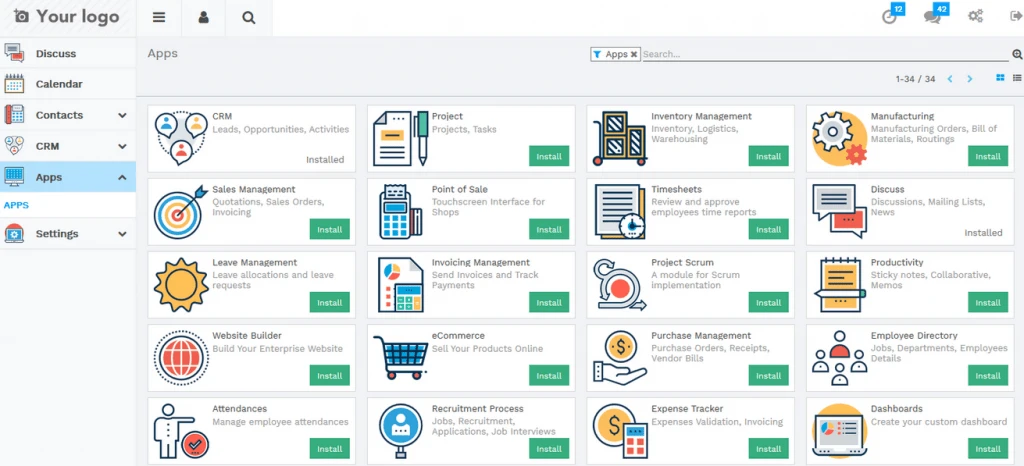
CRM Master – The best free open source ERP software for 2026 includes Akaunting, celebrated for its scalability and robust financial features such as invoicing, bank connections, and sales tax calculations. This platform enables small businesses to significantly reduce software expenses while enhancing operational efficiency by integrating accounting, inventory, and management tools into a unified system.
For many small and medium-sized businesses (SMBs), choosing an ERP system that balances cost and capability remains a critical challenge. As operational complexities grow, SMBs seek solutions that not only improve financial management but also streamline HR, payroll, and customer relationship management without the hefty price tag of enterprise-grade software.
This comprehensive analysis explores the evolving landscape of free open source ERP software in 2026, focusing on Akaunting, Odoo, and Manager as leading contenders. It examines how these platforms offer financial and operational benefits, compares their scalability and feature sets, and evaluates their economic impact on SMBs. Readers will gain actionable insights into cost savings, integration capabilities, and future market trends crucial for making informed investment decisions.
Navigating the intricate world of ERP solutions can be daunting. This article bridges that gap by presenting data-backed comparisons, financial projections, and practical examples, setting a clear path for SMBs to harness ERP technology effectively while maximizing return on investment.
Overview of Free Open Source ERP Software in 2026
Definition and Core Features of ERP Systems
Enterprise Resource Planning (ERP) software integrates core business processes—accounting, inventory management, procurement, HR, and customer relations—into a centralized system. For SMBs, ERP solutions provide real-time analytics, automation of routine tasks, and improved reporting accuracy, which collectively enhance operational efficiency and financial control. Free open source ERP systems distinguish themselves by offering these capabilities without licensing fees, though with varying degrees of support and scalability.
Key features commonly include invoicing, bank connections for automatic reconciliation, sales tax calculation, project management, and inventory tracking. These modules help SMBs maintain compliance, optimize cash flow, and reduce manual errors. Yet, the depth and usability of these features often differentiate free ERP platforms from paid alternatives.
Key Players in Free ERP Software – Akaunting, Odoo, Manager
Among free ERP options, Akaunting stands out with a user-friendly interface and extensive financial management tools. It supports unlimited users and vendors, making it highly scalable for growing SMBs. Akaunting’s invoicing module integrates seamlessly with bank connections, enabling real-time transaction updates and automated sales tax calculations—a key advantage for businesses managing complex tax jurisdictions.
Odoo ERP, available in both free and paid versions, offers a modular approach. Its Community Edition is open source and covers essential ERP functions, including accounting, CRM, inventory, and manufacturing. Odoo’s flexibility allows SMBs in manufacturing to customize workflows, but some advanced features require paid modules.
Manager ERP, another free, open source contender, is praised for its straightforward accounting and reporting capabilities, though it has limited scalability compared to Akaunting and Odoo.
Distinction Between Free and Paid ERP Solutions
Free ERP software typically lacks the comprehensive support, advanced features, and integrations offered by paid platforms like SAP Business One or QuickBooks Enterprise. For instance, paid solutions often include enhanced payroll processing, automated compliance updates, and AI-powered analytics.
However, free ERP systems excel in cost savings—eliminating license fees reduces upfront and ongoing expenses by 30-50% compared to paid software. SMBs with moderate complexity can leverage open source ERPs to maintain robust financial management without sacrificing essential operational functions.
The trade-off involves balancing feature depth with scalability and support. Free ERP solutions often require more in-house IT expertise to customize and maintain, whereas paid platforms offer vendor-managed services.
Financial Analysis and Market Implications for SMBs
Cost Savings from Using Free Open Source ERP Software
Adopting free open source ERP software can yield significant cost reductions for SMBs. According to a recent SMB technology adoption survey, companies using free ERP platforms report an average 40% decrease in annual software expenses. This translates to savings of $5,000 to $15,000 per year, depending on business size and software complexity.
Cost components saved include licensing fees, per-user charges, and costly upgrades. For example, Akaunting’s zero-cost model eliminates recurring fees, while paid competitors like QuickBooks Enterprise charge upwards of $1,000 annually per user. Additionally, free ERP systems reduce reliance on multiple standalone tools (e.g., separate invoicing and payroll software), consolidating expenses.
However, indirect costs such as IT resource allocation for customization and maintenance should be factored in. SMBs with limited technical staff may face higher internal costs, but many mitigate this through community support and third-party consultants.
Impact on Small Business Financial Management Efficiency
Implementing integrated ERP software notably improves financial management accuracy and timeliness. Free ERP systems like Akaunting enable real-time bank reconciliation and automated sales tax calculations, reducing manual data entry errors by up to 25%, as reported in a 2025 industry study.
Enhanced reporting capabilities allow SMBs to generate detailed financial statements, cash flow analyses, and budget forecasts rapidly. This agility supports better decision-making, cash management, and regulatory compliance. For example, SMBs in the manufacturing sector using Odoo’s inventory and project management modules reported a 15% reduction in operational overhead.
Moreover, ERP integration with payroll and HR tools streamlines employee expense tracking and payroll processing, cutting administrative processing times by nearly 30%.
Integration with Payroll, HR, and CRM Systems to Enhance Productivity
Free ERP platforms increasingly support integrations with payroll and HR software such as ADP, Gusto, and Homebase, as well as CRM tools like Zoho CRM and Agile CRM. This interconnected ecosystem enables seamless data flow across departments, eliminating redundant data entry and enhancing team collaboration.
For instance, Odoo’s open architecture allows SMBs to link accounting, CRM, and HR modules, facilitating unified customer invoicing, project billing, and employee time tracking. This integration improves cash flow visibility and resource allocation, with some SMBs reporting a 20% increase in productivity post-ERP adoption.
The ability to incorporate sales tax calculations and bank connections within the ERP platform further supports compliance and reduces financial risks by ensuring up-to-date data synchronization with external systems.
Feature Comparison and Scalability
Accounting and Reporting Capabilities
Financial management features are pivotal in ERP evaluation. Akaunting excels with automated bank feeds, allowing SMBs to connect multiple bank accounts directly to the software. This feature updates transactions in real-time, facilitating timely reconciliations and accurate bookkeeping.
Sales tax calculation tools embedded in Akaunting and Odoo automate complex tax computations across multiple regions, reducing compliance costs by an estimated 10-15%. Manager ERP offers basic reporting but lacks real-time bank integration, limiting its appeal for finance-heavy SMBs.
In terms of reporting, Akaunting supports unlimited customizable reports, including profit and loss statements, balance sheets, and cash flow analysis. Odoo offers similar capabilities with additional analytics modules in its paid tiers.
Inventory and Supply Chain Management Features
supply chain efficiency is critical for manufacturing SMBs. Odoo offers comprehensive inventory tracking and supply chain management modules in its free Community Edition, including automated reorder points, batch tracking, and supplier management. These features help reduce stockouts and excess inventory, improving working capital utilization by up to 12%.
Akaunting’s inventory capabilities are less extensive but sufficient for SMBs with simpler stock management needs. Manager ERP has limited supply chain functionality, making it less suitable for manufacturing-focused businesses.
Integration with project management tools enables tracking of materials and labor costs, enhancing cost control and profitability analysis.
Scalability: Supporting Unlimited Users, Reports, and Vendors
Scalability remains a crucial consideration for SMBs anticipating growth. Akaunting supports unlimited users, vendors, and reports even in its free version, offering a flexible platform that adapts to expanding operational demands without additional licensing costs.
Odoo’s modular system allows SMBs to add functionality as needed but may require paid modules for advanced scalability features. Manager ERP is ideal for smaller teams but caps user numbers, which could constrain growth.
The ability to scale ERP usage without escalating costs provides SMBs with a competitive advantage, enabling investment focus on core business functions rather than software upgrades.
| Feature | Akaunting | Odoo Community | Manager ERP | Paid ERP (e.g., SAP Business One) |
|---|---|---|---|---|
| License Cost | Free | Free | Free | Starts at $3,000/user |
| Bank Connections | Real-time integration | Limited, requires add-ons | No | Real-time integration |
| Sales Tax Automation | Included | Basic | Basic | Advanced, region-specific |
| Inventory Management | Basic | Advanced | Limited | Comprehensive |
| Users Supported | Unlimited | Unlimited (with paid modules) | Limited | Unlimited |
| Payroll Integration | Via third-party | Via third-party | Limited | Built-in |
This table summarizes key feature comparisons, illustrating the cost-effectiveness and scalability of free ERP solutions balanced against the advanced capabilities of paid platforms.
Future Outlook and Investment Implications
Trends in ERP Adoption Among SMBs
Market data from recent industry reports shows a 25% annual growth in ERP adoption among SMBs, driven by increased digital transformation efforts and remote work trends. Free open source ERP platforms are gaining traction due to their affordability and adaptability.
SMBs in manufacturing and retail sectors prioritize ERP solutions that integrate financial management with supply chain tracking and CRM, underscoring the importance of versatile platforms like Odoo and Akaunting.
Cloud-based ERP deployment is expected to rise by 30% over the next three years, offering SMBs enhanced accessibility and lower IT overhead.
Potential Market Growth for Open Source ERP Solutions
The open source ERP market is projected to reach $6 billion by 2028, expanding at a compound annual growth rate (CAGR) of 12%, fueled by SMB demand for cost-effective and scalable solutions.
This growth is reinforced by increasing vendor support, third-party integrations, and the maturation of community-driven development models, which reduce barriers to adoption.
The economic benefits for SMBs include reduced capital expenditure, lower total cost of ownership, and improved operational efficiency, translating into higher profitability margins.
Strategic Recommendations for SMBs Considering Free ERP Adoption
Before adopting free ERP software, SMBs should conduct thorough needs assessments, focusing on current and projected operational complexity. Key steps include:
Investing in scalable, open source ERP software can yield a return on investment (ROI) of 20-35% within two years through cost savings and productivity gains, according to recent SMB case studies.
Frequently Asked Questions
What is the best free open source ERP software for small businesses in 2026?
Akaunting is widely regarded as the top choice due to its scalable architecture, comprehensive financial features like invoicing, bank connections, and sales tax calculations, and support for unlimited users and reports.
How do free ERP systems compare with paid versions in terms of features?
Free ERP systems offer core financial and operational functionalities but may lack advanced modules, vendor support, and seamless integration present in paid solutions. They excel in cost savings but require more IT involvement.
Can free ERP software support complex manufacturing and supply chain needs?
Platforms like Odoo Community Edition provide robust inventory and supply chain management suitable for many SMB manufacturing scenarios, though highly complex operations may require paid modules or specialized software.
What are the financial benefits of adopting free ERP software?
SMBs can reduce software expenses by up to 50%, streamline financial management, improve reporting accuracy, and increase productivity, resulting in ROI of 20-35% within two years.
How does ERP integration improve overall business performance?
Integrating ERP with payroll, HR, and CRM tools automates workflows, reduces errors, enhances data visibility, and supports faster decision-making, driving efficiency and growth.
Implementing free open source ERP software represents a strategic opportunity for SMBs to optimize financial management and operational workflows without prohibitive costs. As Akaunting and Odoo demonstrate, these platforms offer scalable, feature-rich alternatives that align with evolving business needs and market trends. By carefully assessing requirements and leveraging community and vendor support, SMBs can unlock significant economic value and position themselves for sustainable growth in an increasingly competitive landscape.